CN

Clean energy markets are entering a new phase, one defined not by how much renewable capacity is added, but by how effectively it is integrated into the power system.
By Shailesh Telang and Annie Wong
As renewable penetration increases, the focus is shifting from annual energy volumes to when and where clean electricity is actually available, and whether it can reliably meet demand across all hours.
Yet corporate procurement of clean electricity has not kept pace with this shift. Most companies continue to rely on annual matching frameworks, where renewable electricity purchases are aggregated over a year and used to offset total consumption. While this approach supported early renewable growth, it does not reflect the increasingly time-sensitive nature of electricity systems.
A company can purchase renewable energy certificates covering a full year of electricity consumption and claim to be "100% renewable". In reality, for many hours of that year, especially during evening peaks, its factories and offices could actually run on coal or gas power. This gap between accounting and reality undermines trust, weakens price signals, and slows the energy transition. Hourly matching is designed to close that gap.
What Is Hourly Matching?
Hourly matching is the practice of aligning clean electricity supply with actual consumption on an hour-by-hour basis, within the same electricity grid. This is needed because electricity systems operate in real time rather than on annual averages.
As renewable generation becomes more variable, peaking during certain hours and falling to zero in others, annual matching fails to capture whether clean energy is actually available when it is needed.
Hourly matching addresses this gap by linking consumption to the temporal reality of the grid. Rather than tallying renewable generation and consumption over an entire year and calling it a match, hourly matching asks a more demanding question: “Was the electricity you consumed in each specific hour actually backed by clean generation in that same hour and region?”
To understand why, it helps to look at how clean energy tracking has evolved. For over two decades, energy attribute certificates (EACs) such as Guarantees of Origin in Europe and Renewable Energy Certificates in the United States have served as the backbone of voluntary clean energy markets. Their original purpose was straightforward and important: giving renewable generators an additional, tradeable revenue stream. EACs were designed to finance new renewable capacity by enabling consumer energy choice. The priority was to grow the total volume of renewables on the grid, and matching supply to demand on a yearly basis kept the system simple and accessible.
However, as renewable penetration has grown, the limitations of this annual matching are becoming more visible. A solar plant that generates only during midday is treated the same as firm, round-the-clock generation under annual accounting. This masks the growing mismatch between when clean energy is produced and when it is needed.
Research has confirmed that annual matching obscures the growing mismatch between when clean energy is generated and when it is needed. The result is that companies can claim renewable consumption even in hours when no renewables are available, while the system continues to rely on fossil generation for balancing. While technically compliant with current rules, such claims do little to drive the next phase of grid investment actually needed for deep decarbonisation: storage, demand flexibility, and clean firm power that can deliver around the clock.
International Standards Converging on Hourly Matching
The idea of correcting this began gaining traction around 2020, when Google announced its ambition for 24/7 carbon-free energy across all its operations. Since then, the movement has accelerated: the UN-backed 24/7 Carbon-Free Energy Compact has attracted signatories worldwide, the EU has embedded hourly matching into its renewable hydrogen certification rules (known as EU RFNBO) and the Carbon Border Adjustment Mechanism (CBAM). International renewable energy leadership initiatives like the Climate Group's 24/7 Coalition have published criteria for credible hourly claims.
What began as a system and market design consideration is now being embedded into global standards and regulatory frameworks.
Hourly matching is being embedded into the global frameworks that govern how companies report their electricity emissions. Greenhouse Gas Protocol (GHGP) Scope 2 Guidance, an emission reporting standard used by 97% of reporting S&P 500 companies, is undergoing revision. The direction of travel is clear: the proposed revisions would require companies using the market-based method to match their contractual instrument to consumption on an hourly basis and from deliverable grid regions. The revised standard is not a mandate to achieve 100% hourly matching overnight; it is an accounting reform to ensure credible renewable claims.
Running in parallel is the revision of ISO 14064-1, which serves as the basis for third-party-verified carbon footprints in many jurisdictions particularly across Asia. ISO 14064-1 is designed to be compatible with the GHGP. As the GHGP tightens its requirements around temporal and spatial granularity, ISO 14064-1 verified inventories will likely need to reflect the same principles to remain consistent.
The policy stakes for hourly matching rose sharply in late 2025, when the European Commission adopted detailed rules for the definitive phase of its CBAM. From January 2026, importers of carbon-intensive goods into the EU must purchase CBAM certificates corresponding to the embedded emissions of those products. For electricity-related emissions, the default calculation uses country-level grid-average carbon intensity. However, producers who can demonstrate that cleaner electricity was physically delivered and matched in time to their production can apply lower actual emission values which reduces their CBAM costs significantly. Currently, only fertiliser and cement are required to demonstrate electricity related emissions but there are plans to expand the scope of products at the EU commission.
This creates a direct commercial incentive for hourly matching. Manufacturers in export-oriented economies, particularly in the Asia-Pacific region, who secure physically deliverable and hourly matched clean electricity through power purchase agreements (PPAs) can improve their competitiveness in EU markets. Conversely, those relying on annual certificates alone will be unable to move beyond conservative default emission values.
How to Achieve Hourly Matching
Energy Tag has developed the global open-source standard for Granular Certificates (GCs): EACs issued with a time resolution of one hour or less. Where a traditional EAC might simply state that a wind farm produced 1,000 MWh in March, a Granular Certificate would specify exactly how much was generated in each hour of that month, giving buyers and regulators a far more accurate picture of when clean power was delivered.
GCs build on detailed electricity system data, including metering, asset characteristics, and registry-based verification, to attach time-stamped attributes to clean energy generation. This makes it possible to track when clean power is produced and align it with consumption. In this sense, GCs are the foundational infrastructure layer that enables hourly matching. They provide the verified, time-stamped data upon which such frameworks can be built.
Think of GCs as the time-stamped environmental attribute tracking measuring instrument, and hourly matching uses this information to align supply with consumption. Hourly matching as the measurement itself. The broader "24/7 carbon-free energy" concept is the aspiration. GCs and hourly matching are the tools that make that aspiration verifiable.
Multiple registries around the world are already issuing or developing GC capabilities, including Energinet in Denmark and T-RECs in Taiwan etc. EnergyTag accredited its first GC issuers in 2025, marking a milestone in establishing trusted, interoperable hourly tracking systems.
Enabling hourly matching requires three key elements: granular metering data from generation assets, a registry or tracking system capable of issuing time-stamped certificates, and a matching process that compares hourly production with hourly consumption.
In practice, hourly meter data from renewable generators is already widely available: smart meters and grid operators record at 15-minute to 30-minutes intervals in most developed markets. The primary infrastructure challenge lies in upgrading certificate registries to handle hourly issuance, transfer, and retirement at scale.
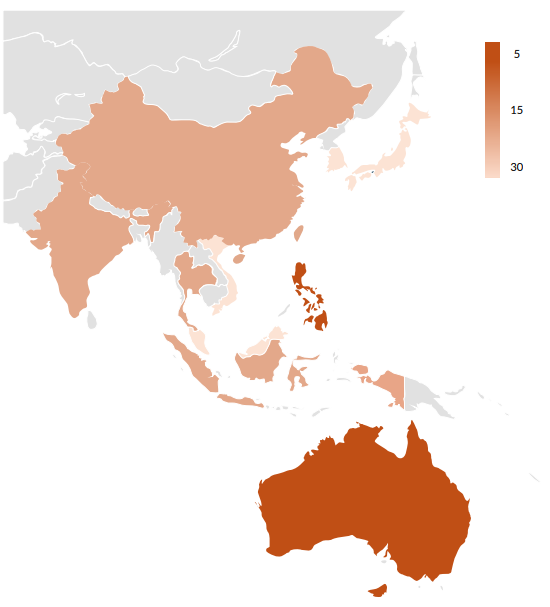
Fig. 1 — Balancing periods across selected APAC electricity systems. Source: EnergyTag
EnergyTag’s standard is designed to support multiple implementation pathways depending on market readiness. These range from independent granular certificate schemes to approaches that operate in coordination with existing EAC systems, to models that link granular certificates to canceled EACs, enabling a gradual transition without disrupting current market structures.
The institutional costs are real but manageable. Registry systems require software upgrades, and verification processes must be adapted. However, because the underlying data already exists in most electricity markets, the incremental cost of granular tracking is far lower than building an entirely new system. Early implementations, such as Google's global portfolio of over 10 TWh into hourly certificates, have demonstrated that the process is technically feasible at scale.
Hourly Matching Will Boost Investment in Energy Storage
Hourly matching also sends a powerful investment signal. Under annual accounting, there is little financial reward for generating clean power during high-demand evening hours rather than sunny midday hours when solar is abundant and cheap. Hourly matching changes this calculus: clean electricity at the hours where it is most needed becomes more valuable.
This is where energy storage and demand flexibility become critical. Battery systems can absorb surplus renewable generation and discharge it during hours of deficit, extending clean energy coverage across the clock. Under an hourly matching framework, these assets earn recognition for the temporal value they provide and create new revenue streams for investment in flexible infrastructure.
For corporations, this translates into a practical shift in procurement strategy.
Companies pursuing hourly matching are increasingly turning to hybrid or multi-technology portfolios combining solar, wind, and battery storage that deliver a firmer, more round-the-clock supply profile.
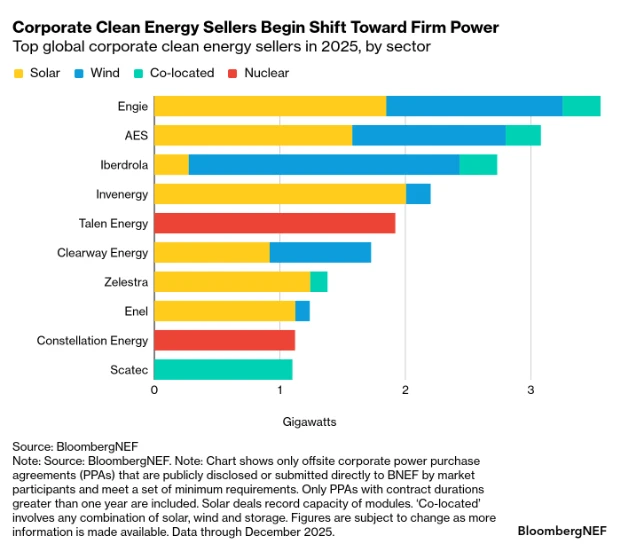
Analysis from the IEA has found that hybrid wind, solar, and battery portfolios can meet 80% of baseload demand at costs competitive with industrial retail electricity tariffs in the United States, Europe, and China.
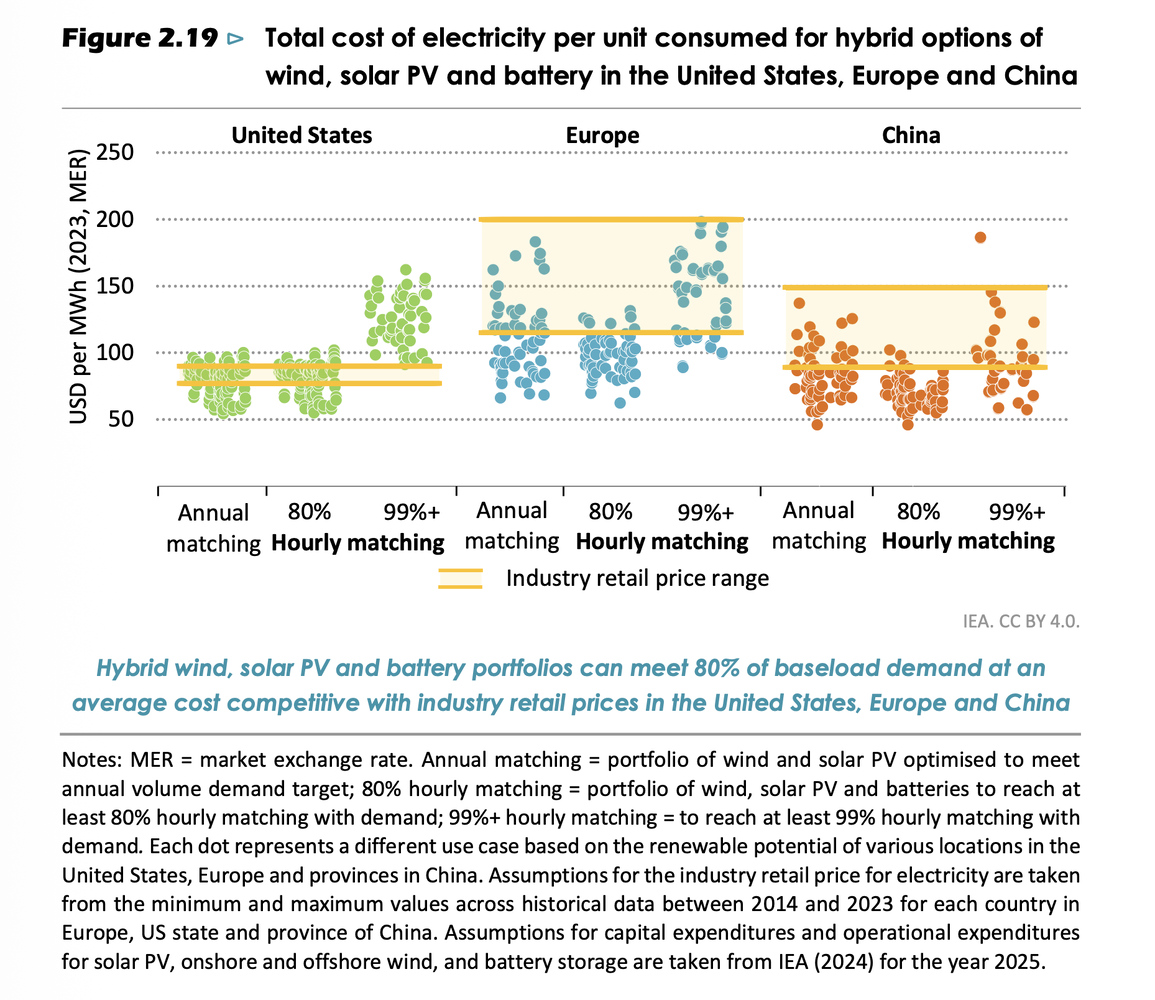
Source: IEA, Energy and AI, 2025. IEA. CC BY 4.0.
More suppliers are providing firm PPAs, and retailers are offering hourly matching green tariffs, as an option, with volume growing in the US and Europe.
However, this shift does not happen by corporate action alone, it requires enabling market design and regulation.
Governments and regulators can accelerate adoption by designing more flexible renewable energy procurement frameworks that reward time-aligned clean energy and by incorporating hourly matching principles into government-led tenders and auctions. India's round-the-clock renewable tenders offer early examples of how policy design can pull hybrid procurement into the mainstream.


Contact Us:zerocarbon2060@outlook.com




copyright@2025 零碳时代,All Rights Reserved 备案号:闽ICP备14008486号-14
Fill out the form to receive a free electronic version of the magazine