CN

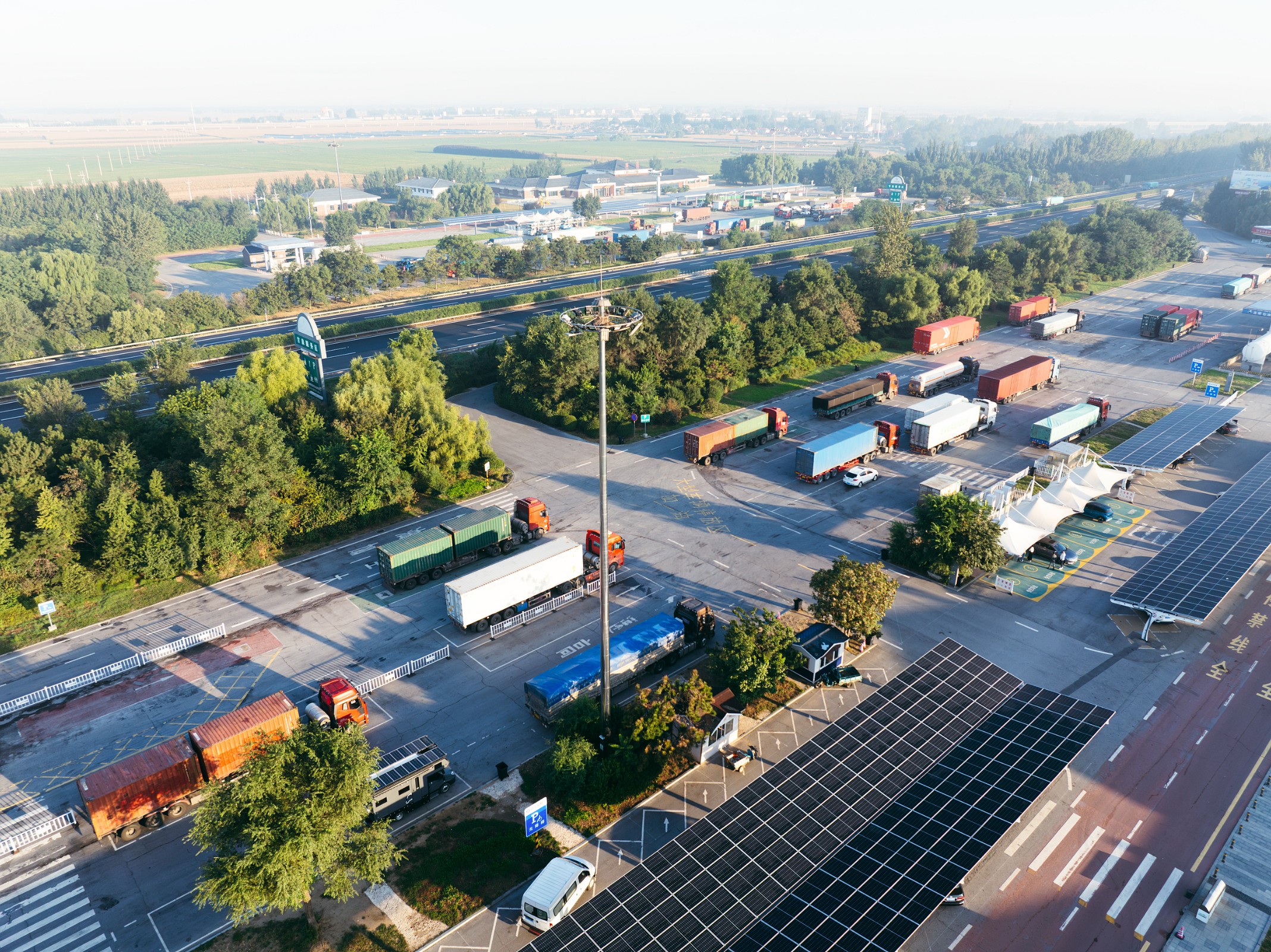
China’s latest policy package signals a shift from promoting clean trucks to building the infrastructure and logistics systems needed for large-scale freight decarbonisation.
Written by Xinyi Shen and Yedan Li | Edited by Shulin Han
China has unveiled a new round of policy support for new energy heavy-duty trucks, signalling a shift in focus from subsidising vehicle purchases to building the infrastructure needed for large-scale freight decarbonisation.
In June 2026, 11 government agencies, including the Ministry of Transport, the National Development and Reform Commission (NDRC), and the Ministry of Industry and Information Technology (MIIT), jointly released an implementation plan to scale up deployment of new energy heavy-duty trucks, including electric and fuel-cell vehicles.
The plan calls for the construction of around 3 000 charging and battery-swapping stations for heavy trucks, the development of 30 000 kilometres of zero-carbon freight corridors, and wider adoption of new energy heavy-duty trucks across different freight applications.
Earlier this year, an outline of China’s 15th Five-Year Plan (2026–2030) also identified zero-carbon transport corridors as a national priority, proposing the coordinated deployment of charging, battery-swapping, hydrogen, ammonia and methanol refuelling infrastructure, together with integrated renewable power and energy storage systems along major freight routes.
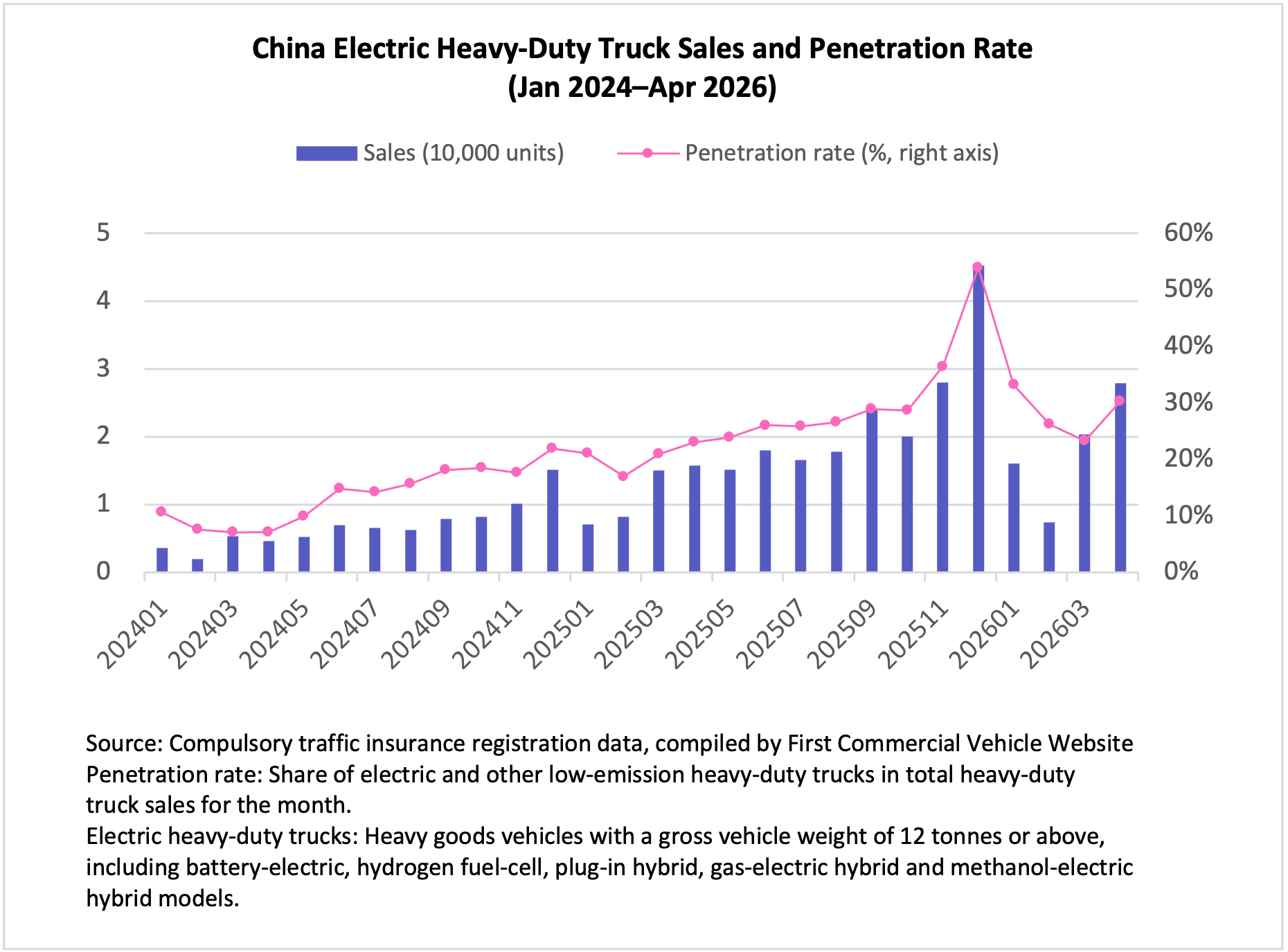
The policy comes at a time of rapid expansion within China’s electric heavy-duty truck market. In 2025, nearly three out of every ten new heavy-duty trucks sold in China were electric. Despite the gradual phase-out of purchase tax exemptions and vehicle replacement subsidies, electric trucks accounted for more than half of all new heavy-duty truck sales in December—the first time they had crossed the 50% mark in a single month. Large-scale deployment was already underway in ports, mines and steel plants, where fixed transport routes and predictable operating patterns have made electrification commercially viable.
According to BloombergNEF, China has sold about 17 times as many clean trucks as Europe so far this year, and is expected to remain the world’s largest market for electric commercial vehicles in 2026. Although purchases were front-loaded at the end of 2025, sales remained strong.
Industry data show that 103 000 electric heavy-duty trucks were sold during the first five months of 2026, up 68% from a year earlier.
In other words, nearly one in every three new heavy-duty trucks sold in China during the period was electric.
Falling battery costs, improvements in vehicle performance and the continued expansion of charging and battery-swapping infrastructure have helped sustain this momentum.
The latest policy package suggests that the next phase of China’s freight electrification will be defined less by how many new trucks are sold and more by how quickly an integrated transport system can be built. Rather than focusing solely on vehicle deployment, policymakers are increasingly prioritising the coordinated development of charging networks, freight operations and energy infrastructure along major logistics corridors, pointing towards a more systemic approach to freight decarbonisation.
Why New Energy Heavy-Duty Trucks?
Heavy-duty trucks are emerging as one of the most important frontiers for decarbonising China’s transport sector.
Road freight underpins China’s transport system and is also one of its largest sources of emissions. According to existing research, transport accounts for roughly 12% of China’s total carbon emissions, with road transport responsible for more than 80% of emissions from the sector. Heavy-duty trucks make up only a small share of the vehicle fleet, yet generate nearly half of all road transport carbon emissions.
Their environmental impact extends well beyond carbon dioxide (CO2). According to the 2025 China Mobile Source Environmental Management Annual Report published by the Ministry of Ecology and Environment, freight trucks accounted for 83% of nitrogen oxide (NOx) emissions and more than 90% of particulate matter (PM) emissions from the country’s vehicle fleet in 2024, with heavy-duty trucks contributing the largest share. Decarbonising freight is therefore essential not only for achieving China’s climate goals, but also for improving air quality.
The challenge is particularly significant because of China’s industrial structure. China, the world’s largest manufacturing economy, also has the world’s largest road freight market. The movement of steel, coal, iron ore, construction materials, agricultural products and containers relies heavily on trucks. Heavy-duty vehicles connect mines, steel mills, ports, logistics hubs and manufacturing centres, making them a critical link in both industrial production and supply chains. As a result, decarbonising freight is not simply a transport issue—it is now part of China’s broader industrial transition.
Until now, most industrial decarbonisation efforts have focused on production itself. Steelmakers have invested in ultra-low-emission upgrades, electric arc furnaces and hydrogen-based steelmaking, while mining companies have begun electrifying mining equipment and expanding the use of renewable energy.
By comparison, the logistics connecting mines, factories, ports and end markets has remained heavily dependent on diesel-powered trucks, making freight one of the weakest links in supply-chain decarbonisation.
That picture is beginning to change.
Falling battery costs, improvements in vehicle performance and the rapid expansion of charging and battery-swapping technologies have enabled electric heavy-duty trucks to move beyond demonstration projects towards large-scale commercial deployment. Adoption has been particularly successful in closed or semi-closed industrial environments, such as ports, steel plants and mines - where transport routes are fixed, utilisation rates are high and charging infrastructure can be planned alongside fleet operations. These early deployments have demonstrated not only the technical feasibility of electric heavy-duty trucks, but also their commercial viability.
This explains why China’s latest policy package places greater emphasis on infrastructure than on additional vehicle subsidies. The next challenge is not simply to put more clean trucks on the road, but to ensure that they can operate efficiently at scale.
Over the longer term, continued growth in the sector will depend not on purchase incentives but rather on the availability of charging and battery-swapping networks, reliable clean energy supplies and efficient freight operations.
As zero-carbon freight corridors begin to connect steel mills, mines, ports and logistics hubs, they may reshape not only how goods are transported, but also how industrial supply chains are organised. In that sense, the significance of China’s latest policy shift extends well beyond the transport sector itself.
From Subsidising Trucks to Building Networks

One reason electric trucks have scaled up so quickly in recent years is that they were first deployed in environments where operating conditions naturally favoured electrification. Ports, mines and steel plants typically feature fixed routes, short transport distances and highly coordinated fleet management, allowing operators to develop integrated plans that include vehicles, charging or battery-swapping infrastructure, and logistics. Under these conditions, the economic advantages of electric trucks become much easier to realise.
The steel industry provides perhaps the clearest example. A recent study jointly published by Clean Air Asia and Tsinghua University’s School of Environment found that policies such as ultra-low-emission retrofits and environmental performance rating schemes have created favourable conditions for the large-scale deployment of electric heavy-duty trucks. Rather than relying solely on vehicle subsidies, the sector has developed a model in which policy support, suitable operating scenarios and commercial viability reinforce one another.
Hebei Province illustrates how this integrated approach has evolved.
Of the steel plants that had completed ultra-low-emission retrofits by 2025, electric trucks accounted on average for 93% of on-site transport, while some facilities had fully electrified their internal logistics. Electrification has also expanded beyond plant boundaries: for inbound and outbound transport, electric trucks typically account for more than 70% of freight movements, reaching up to 90% at some sites.
Importantly, many steelmakers have invested simultaneously in charging and battery-swapping facilities and have coordinated fleet scheduling and battery-swapping operations. Their experience suggests that the rapid adoption of electric trucks depends not only on improvements in vehicle technology, but equally on the development of supporting infrastructure and more efficient operational systems.
However, these early successes have largely been confined to closed or semi-closed industrial environments.
As electric heavy-duty trucks move beyond ports, mines and steel plants into regional distribution networks and long-haul freight, a different set of challenges begins to emerge. The main bottleneck is no longer the vehicle itself, but the availability of reliable charging and battery-swapping infrastructure.
For long-distance freight operators, the convenience of charging, the speed of energy replenishment and access to reliable supplies of green electricity directly affect fleet utilisation and operating costs. The same Clean Air Asia study identifies several remaining barriers, including insufficient charging and battery-swapping networks, underdeveloped service ecosystems and increasingly complex fleet scheduling.
The next phase of market development, therefore, requires a shift from promoting individual vehicle acquisitions to building the infrastructure, business models, and industry partnerships needed to support large-scale operations.
This explains why the new implementation plan places the expansion of charging and battery-swapping infrastructure at the top of its agenda. It calls for the construction of around 3 000 charging and battery-swapping stations for heavy-duty trucks, the development of 30 000 kilometres of zero-carbon freight corridors, and the installation of dedicated charging facilities at motorway service areas.
The plan also promotes integrated energy hubs that combine renewable power generation, energy storage, charging and battery swapping, alongside direct renewable electricity supply, greater local renewable energy consumption, and vehicle-to-grid (V2G) technologies. Together, these measures are intended to help integrate freight electrification within the wider energy system.
In other words, the next stage of development in China’s electric heavy-duty truck market will not be determined solely by vehicle performance or battery technology. Increasingly, it will depend on who can build the most efficient charging networks, secure reliable clean energy supplies and optimise freight operations.
If the first phase of the industry’s development was about proving that electric trucks could work in specific operating environments, the next phase is about creating a transport system capable of supporting large-scale, long-distance freight electrification. That transition will ultimately determine whether electric heavy-duty trucks can move beyond niche industrial applications and become a mainstream solution for road freight.
From Demonstration Projects to Freight Systems
If charging infrastructure determines whether electric heavy-duty trucks can operate efficiently, the breadth of their deployment will determine whether they can achieve truly large-scale adoption.
Reflecting this shift, China’s latest plan identifies the expansion of application scenarios as another key priority. It calls on large transport operators, logistics companies, and commercial freight fleets to accelerate the adoption of new-energy heavy-duty trucks, while targeting sectors such as steel, mining, coal-fired power, non-ferrous metals, coking, and coal chemicals. The plan also encourages the development of zero-carbon freight corridors along some of China’s busiest commodity transport routes, including coal shipments from Xinjiang and from Shanxi–Shaanxi–Inner Mongolia, as well as the country’s major north-to-south grain transport corridors.
The implications are significant. Electric heavy-duty trucks are no longer being promoted simply as vehicles for individual companies or industrial parks. Increasingly, they are becoming part of a broader effort to decarbonise regional logistics networks and the national freight system.
That transition is already beginning to take shape.
In April 2025, China launched its first commercially operated regional electric heavy-duty truck corridor along a roughly 250-kilometre route between Ningbo and Yiwu. Running along the Yongjin Expressway, the corridor links Ningbo-Zhoushan Port with the Yiwu International Trade City and will be supported by ten dedicated charging and battery-swapping stations, creating a continuous energy-replenishment network along the route. Carrying around 1.3 million twenty-foot equivalent units (TEUs) of container traffic each year, it can accommodate the high and predictable freight volumes needed to support large-scale electric truck operations.
An initial fleet of 300 electric heavy-duty trucks is expected to reduce carbon emissions by around 48 000 tonnes per year while cutting operating costs by approximately RMB 84 000 per vehicle each year. More importantly, the project shows how electric heavy-duty trucks are beginning to move beyond the closed industrial settings where they first gained traction and into open-road, regional freight transport.
A similar evolution is underway in bulk commodity logistics. Earlier this year, Huayuan Landport Group and Shanxi Coking Coal Group launched a fleet of 100 battery-swapping heavy-duty trucks as part of a zero-carbon freight corridor in Zuoyun County, Shanxi Province. Unlike the Ningbo–Yiwu corridor, which focuses primarily on transport infrastructure, the Shanxi project integrates vehicle operations, battery-swapping services, freight scheduling and energy supply within a single operating model. Logistics operators, cargo owners, battery suppliers and technology providers each play defined roles, creating a more comprehensive solution for decarbonising coal transport.
Although these two projects serve different industries, they point in the same direction. The focus is shifting from electrifying individual fleets or transport routes to building integrated freight systems where vehicles, charging infrastructure, energy supply and logistics operations are planned together. Freight electrification is gradually expanding from fixed industrial routes towards interconnected regional transport networks.
These developments reflect an important distinction between China’s approach and developments in other parts of the world. Globally, transport electrification has made significant progress in closed operating environments such as mines, ports and industrial sites, where international mining companies and logistics operators are increasingly working with Chinese battery manufacturers and equipment suppliers. However, large-scale efforts to connect these isolated projects through open-road, cross-regional zero-carbon freight corridors remain relatively limited.
China is now pursuing a more systemic approach: treating freight decarbonisation as a system rather than a collection of individual vehicle deployments.
That is also the broader significance of the “zero-carbon transport corridors” proposed in China’s 15th Five-Year Plan outline. Rather than simply putting more electric trucks on the road, the strategy aims to coordinate charging and battery-swapping facilities, hydrogen, ammonia and methanol refuelling infrastructure, renewable electricity generation, energy storage and freight operations along major logistics corridors. In other words, the objective is to integrate transport, energy and industrial policy into a single decarbonisation framework.
The latest implementation plan reinforces this objective. Alongside vehicle deployment, it emphasises the coordinated development of charging infrastructure, renewable electricity supply, digital freight platforms and transport operations.
It also proposes new industry alliances linking roads, vehicles, logistics and energy systems, while encouraging innovative business models such as vehicle–battery separation, battery leasing and integrated energy services.
The future competitiveness of China’s freight sector will therefore depend not simply on who manufactures the best electric truck, but on who can build the most efficient low-carbon freight ecosystem.
Uncertainties remain. There are lingering questions over the economics of charging infrastructure, the availability of renewable electricity, cross-regional operating models, technical standards and the commercial value of low-carbon freight services.
Yet one conclusion is already becoming apparent: the focus of China’s freight electrification strategy has fundamentally changed. The first phase was about replacing diesel trucks with electric and fuel-cell ones.
The next phase is about building a transport system that enables those vehicles to operate efficiently at scale.
Over the past decade, China’s electric vehicle revolution has largely been defined by passenger vehicles. During the 15th Five-Year Plan period, however, a new phase of the transition may unfold in freight transport, where vehicles, energy systems, infrastructure and logistics networks are being redesigned together.
Whether China’s vision of zero-carbon freight corridors can move from policy to widespread implementation will shape the future of the heavy-duty truck industry and the decarbonisation of steel, mining, coal and logistics supply chains. It will also provide an important indicator of China’s broader industrial transition towards a low-carbon economy.
English edited by Helen Farrell

Contact Us:zerocarbon2060@outlook.com




copyright@2025 零碳时代,All Rights Reserved 备案号:闽ICP备14008486号-14
Fill out the form to receive a free electronic version of the magazine