CN


Solar PV combined with battery storage is the most viable solution for the nearly 2 billion people worldwide who lack access to reliable electricity.
By Qiaoman Zhang | Interviewed and Edited by Shulin Han
Australia’s battery storage boom is profoundly reshaping the country’s electricity system, and it may well represent the grid evolution trends beyond China.
Australian Climate Change and Energy Minister Chris Bowen revealed on 16 May that more than 420,000 household battery systems had been installed across Australia in just over 10 months, adding 11.2 GWh of distributed storage capacity. That figure is roughly equivalent to the volume of utility-scale battery storage added to the National Electricity Market (NEM) over the same 12‑month period. According to the Australian Energy Market Operator (AEMO) , 4.45 GW/11.2 GWh of new large‑scale battery capacity was connected to the grid between the end of the first quarter of 2025 and the end of the first quarter of 2026.
The simultaneous surge in both household and utility‑scale storage has not only cemented Australia’s position as the world’s third‑largest energy storage market, but also delivered profound changes to the operation of its power system and electricity market. AEMO’s Quarterly Energy Dynamics (QED) report for Q1 2026 shows that batteries set the price in 32% of trading intervals during the quarter, overtaking hydro as the most frequent price‑setting technology in the NEM. With greater battery charging and discharging capacity, the frequency of negative daytime prices has fallen, evening peak prices have softened, and the overall wholesale electricity price declined by 12% year‑on‑year compared with Q1 2025.
Steve Blume , Secretary and Immediate Past President of the Australian Smart Energy Council , is one of Australia’s most experienced energy experts, having held leadership positions in numerous solar and energy storage-related think tanks and associations across Australia and the Asia-Pacific region, with decades of expertise in solar PV, energy storage and grid policy. He has visited China multiple times a year since 2009. During the SNEC 2026 Shanghai, he stated in an interview with Net Zero Age that what is happening in Australia and California will be the future of the grid.
Blume noted that thanks to the rapid increase in energy storage installations, the duck curve — caused by rising solar PV penetration — is being reshaped: the belly of the duck has lost weight and its head has been chopped off. Wholesale electricity prices have fallen for the first time in nine years. Batteries are now injecting more power into the grid than all gas peaker plants combined. And in South Australia’s recent Firm Energy Reliability Mechanism (FERM) tender, all winning projects were battery storage systems, with no gas projects securing any contracts.
Blume believes this transformation is not an exception but a preview of what is to come for grids in many countries. In his view, geopolitical crises will accelerate the global push for energy independence, and solar PV combined with battery storage is the most viable solution for the nearly 2 billion people worldwide who lack access to reliable electricity.
Below is the full text of the interview.
Energy Storage Reshaping the Grid
Net Zero Age: Australia’s household battery storage boom stands out globally. What has driven the explosive growth of energy storage in Australia?
Steve Blume: All of this came from a clear government policy and commitment to support private investment. The policy was the Cheaper Home Batteries Program, announced in May 2025 and launched on 1 July 2025. It provided around a 30% upfront discount for households and small businesses to install battery storage alongside rooftop solar, backed by an initial (.3 billion budget over four years. The government’s initial commitment was (.3 billion. However, this public funding leveraged around = billion of private investment, because households and businesses also put their own money into the systems.
It was a no‑brainer, as there was no financial risk for the government – all the finance, risk, and benefit were private, but the whole community shared the upside. By December 2025, the scheme had already exceeded expectations. To keep it running through to 2030, the government added another A> billion, bringing total funding to an estimated A--.2 billion.
Net Zero Age: Large-scale storage installations in Australia are also growing rapidly. What impact has the rapid deployment of energy storage had on grid operations? And what are the landmark changes?
Steve Blume: The well‑known duck curve is now changing: The belly of the duck has lost weight and the head is being chopped off.
This is happening without any direct control by the grid over the batteries; it is driven simply by self‑consumption from the households and businesses that own the batteries. This is already reducing peak demand on the grid, and at the same time wholesale electricity prices have dropped. In fact, we have just seen the first decline in wholesale electricity prices in 9 years – a very significant drop.
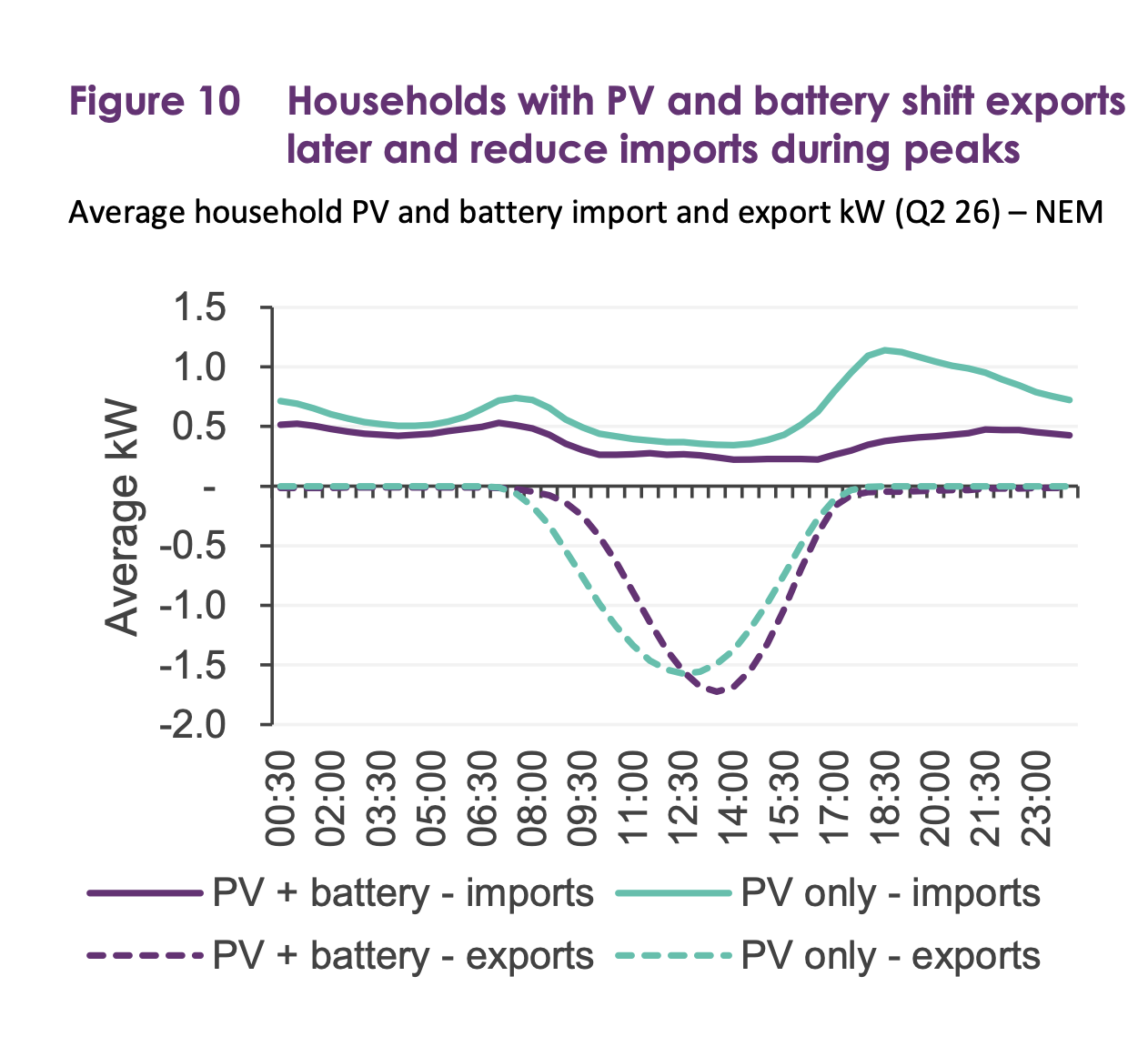
Figure 10. Households with PV and battery shift exports later and reduce imports during peaks. Source: AEMO, Quarterly Energy Dynamics Q2 2026.
The government has also introduced three free hours of electricity for about three‑quarters of the population, starting around 1 August. This gives everyone three hours of free power in the middle of the day, which helps to shave off the massive midday surplus.
a) Last year, on seven non‑consecutive days, South Australia’s rooftop solar alone generated more than 110% of the state’s electricity demand. South Australia can do this because it is part of an interconnected grid and can export the surplus to other states.
b) On 29 May this year, South Australia announced the results of the first round of its Firm Energy Reliability Mechanism (FERM) tender, aimed at supporting its highly renewable grid. The state is targeting 100% renewable electricity by early 2027, serving a population of approximately 3 million. Gas peakers also participated in the tender, but none were awarded contracts; all successful bids came from battery storage projects, comprising six long-duration storage systems with durations of 4, 6, and 8 hours.
c) Nationwide, in the fourth quarter of last year, renewables including storage supplied 51% of the NEM energy needs, marking the first time renewable generation exceeded half of quarterly supply. In November last year, large batteries on the NEM discharged more energy than peaking gas generators for the first time.
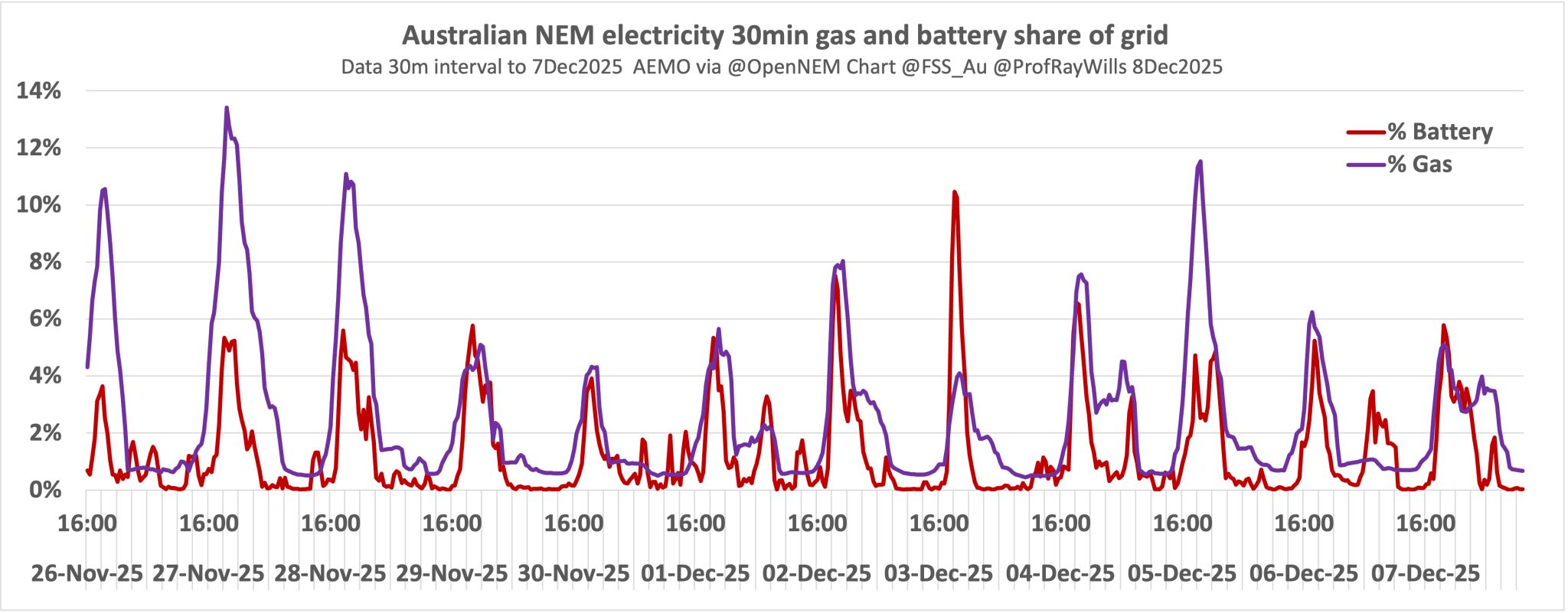
In late November and early December 2025, large batteries on the NEM discharged more energy than peaking gas generators. Source: AEMO
Australia's grid remains coal-based, but coal can no longer run at full capacity because renewables are cheaper and receive dispatch priority. This is tied to the market design: the NEM uses a marginal clearing mechanism. Wind and solar have near-zero marginal generation costs, allowing them to bid low and enter the market first, while in many periods they receive the higher marginal clearing price, capturing excess returns.
We have a coal-fired network basically, and over 60% of our generation is black coal. But for the first time, in the last 12 months, more than 50% of our annual generation is now from renewables. This means coal is running sub‑optimally; it cannot run at full capacity because renewables get priority. They're lower cost.
Our electricity market is designed in a special way: gas peakers submit their bids, and the price is set by the highest bidder. But the people who can access most of the renewables go in first. So they get the high price for doing it. That is how the market works.
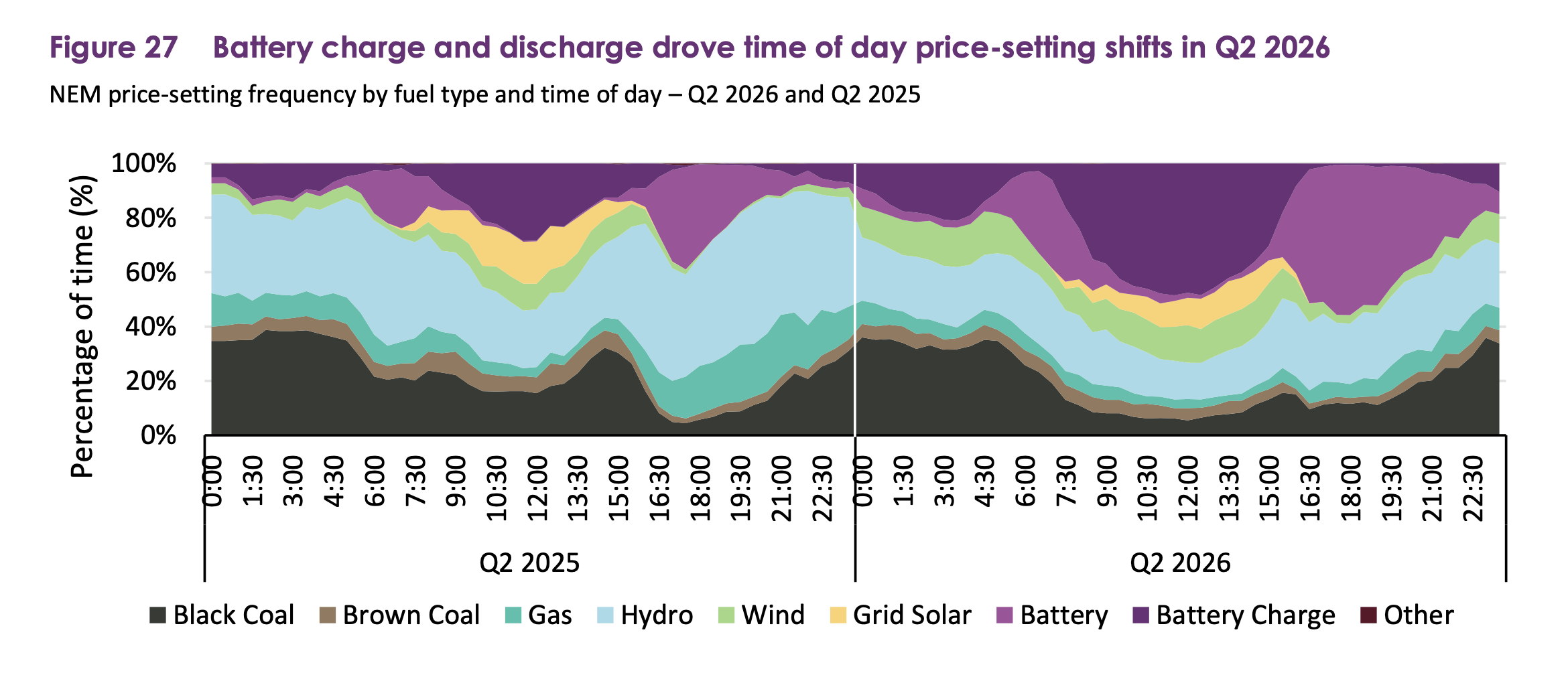
Figure 27. Battery charge and discharge drove time of day price-setting shifts in Q2 2026. Source: AEMO, Quarterly Energy Dynamics Q2 2026.
Meanwhile, in California, solar is now powering the grid at night more than it produces during the day. The old phrase used to be: if the sun isn’t shining and the wind not blowing, renewables don’t work well. Until you put a battery in, you can time-shift the energy to when you want to use it. More and more of the energy generated in the middle of the day is now being used at night.
So the notion that renewables fail when the sun doesn’t shine and the wind doesn’t blow is simply nonsense because we've got batteries. California has been doing this for at least four months, and with more batteries and more solar being added, it is not going backwards.
Net Zero Age: Do you think that this what is happening in Australia and California will be the future of the grid?
Steve Blume: It is definitely the future of the grid. And the grid is more distributed than that too.
The grid is moving out and down: outward, to cover a wider geographic area; downward, to reach individual users.
This means it is shifting from a centralized, one‑way system dominated by a few large power plants to a flattened, distributed, bidirectional structure powered by countless small sources, like rooftop solar, batteries, and more. What's driving this change is lower costs and faster deployment.
The benefits are very clear. As everyone here knows, people with batteries have the lowest‑cost electricity, the fastest deployment, and the lowest emissions. The barriers to rapid deployment are not technical, but social and public.
We are in a war, and the fossil fuel industry is doing most of the fighting. They already know they have lost. The only question now is how much time remains before they make their last stand.
Net Zero Age: What kind of storage will have a bigger market opportunity here in Australia?
Steve Blume: That depends. For grid‑connected storage, one technology stands out: black‑start capable batteries with black‑start inverters. I have visited several companies and factories here, and this capability is becoming very valuable.
Another promising area is grid‑forming. They enable a truly resilient, self‑operating system that monitors itself and decides what to do. You simply connect the equipment, switch it on, and the system says “I am a grid now.” It self‑starts and creates a grid. You have your load, your PV, your battery….everything comes online automatically. It is extremely smart.
CATL , HUAWEI , GoodWe all have similar technologies. This means you can deploy storage very quickly, which is especially important for Australia’s many remote communities with weak grid connections.
Middle East crisis speed up energy transitions
Net Zero Age: The global energy market this year has been impacted by the war in the Middle East. What impact do you think this war will have on the global energy transition?
Steve Blume: Geopolitical crises are likely to accelerate the energy transition. Two things have become clear.
First, many people simply had not realized – or never seriously thought about – their dependence on external energy suppliers. Take Bangladesh as an example: 30% of its electricity generation used to come from oil‑fired plants. That supply is now gone. The country is on rations, facing blackouts and brownouts. Even an affluent country like Malaysia has been heavily subsidizing oil and diesel – about 700 million ringgit per month. Three weeks after the oil crisis started, that subsidy burden has ballooned, and the situation has become unsustainable.
Second, oil prices are not going to fall for at least 12 to 18 months, and supply from the Middle East will not return anytime soon. At the same time, global oil reserves are being rapidly drawn down. What this reveals is a lack of resilience and insufficient sovereign capacity to cope with such shocks. The crisis will eventually pass – perhaps within 12 to 18 months I think longer – but no one will forget this experience. As a result, countries will move decisively toward greater energy independence and cleaner, more reliable domestic sources.
Net Zero Age: Apart from Australia, do you see any energy transition trends in other parts of the world?
Steve Blume: Nearly half a billion people in Southeast Asia and South Asia , including the Philippines, Indonesia, Malaysia, Thailand, Cambodia, Bangladesh, and Pakistan, still have no access to electricity at all. In total, close to 2 billion people in this region (excluding China and India) are severely underserved, lacking reliable power for their daily lives.
Building new coal or nuclear power plants, along with the massive transmission networks they require, is neither realistic nor fast enough to solve this problem. The existing grids are often old, poorly maintained, and in urgent need of repair.
The only practical and rapidly deployable solution is solar PV combined with battery storage. Even for islands or remote communities that currently rely on diesel generators, adding solar and batteries transforms the system. Instead of constantly ramping up and down to follow load changes – which shortens generator life and increases strain – the diesel generator can now run at its optimal level. It will use far less fuel than if it were operating alone, and with this setup, you can achieve up to 80% clean electricity.
The result is cheaper power, lower emissions, and, most importantly, independence from external diesel supply. While you may still buy solar panels and batteries from China, you are no longer dependent on anyone for diesel fuel.

Contact Us:zerocarbon2060@outlook.com




copyright@2025 零碳时代,All Rights Reserved 备案号:闽ICP备14008486号-14
Fill out the form to receive a free electronic version of the magazine