CN

The sodium battery industry has developed to a point reminiscent of the lithium iron phosphate (LFP) battery technology breakthrough of 2020, and is poised to enter the energy storage sector.
Written by Mingze Ma | Edited by Shulin Han
Sodium-ion batteries are transitioning from laboratory novelties into GWh-scale commercial realities.
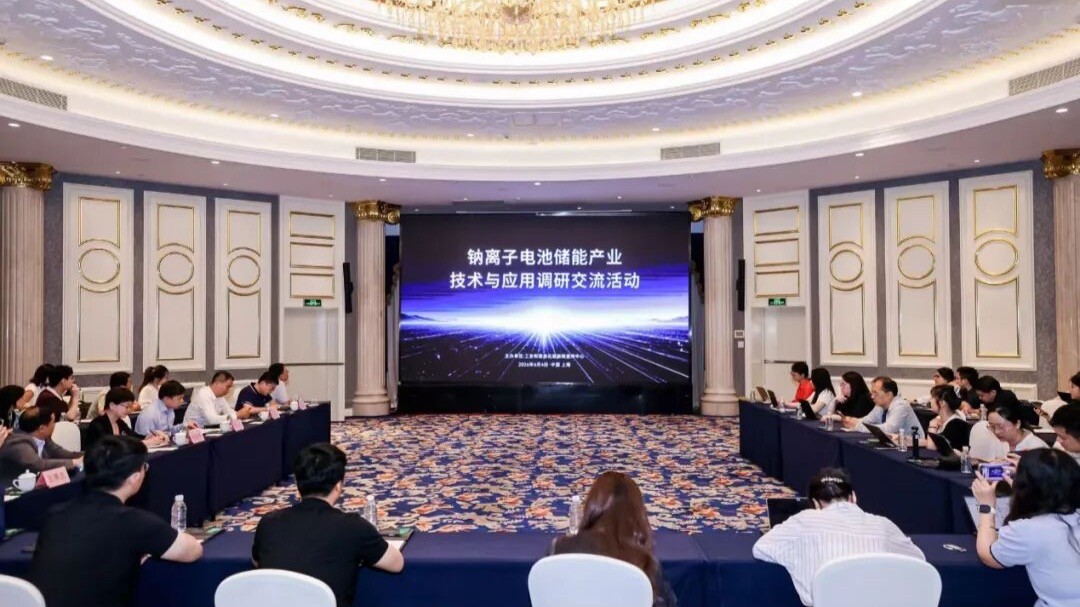
On 4 June 2026, at the annual International Photovoltaic Power Generation and Smart Energy Conference & Exhibition( SNEC ) , an event titled "Research on the Industrial Technology and Application of Sodium-Ion Battery Energy Storage" was hosted by the Information Center of Ministry of Industry and Information Technology (MIIT) in PRC.
Core players from all parts of the sodium battery supply chain shared the latest progress in the development of sodium-ion battery technology.
The key componets of a battery are the cathode, anode, elevtrolyte and separator.
Compared with lithium-ion batteries, sodium-ion batteries rely on markedly different cathode and anode materials. In the mainstream technology route, cathode is polyanion-based, while the anode uses hard carbon. The separator and electrolyte are similar to those in lithium batteries.
Today, Ningbo Ronbay New Energy Technology Co., Ltd has started large-scale production of sodium battery cathode materials, using both polyanion and layered oxide. The production capacity of these two technology routes could expand to 28 000 metric tons during 2026.
On the anode side, Wanhua Chemical Group has engineered two hard carbon technology routes — coal-based and resin-based, — overcoming the early reliance on biomass feedstocks (coconut shells). The new technologies have already been applied in thousand-ton-level production lines this year.
CATL is on track to deliver its first batch of sodium battery energy storage systems this September, reaching GWh-scale production during 2026.
On the application front, Beijing HyperStrong Technology Co., Ltd is preparing to commission a lithium-sodium hybrid energy storage demonstration project later this year.
Compared to lithium batteries, the advantages of sodium-ion batteries include
a wider range of operating temperatures
higher safety standards
high rate capability
a longer lifecycle
much more abundant mineral resources
These make them particularly suitable for energy storage, low-temperature applications, startup and backup power, and two-wheeled vehicles.
Sodium resources on Earth are basically inexhaustible and extremely low-cost. China depends heavily on lithium imports, whereas it is much easier to find resources for sodium batteries.
However, a key drawback of sodium batteries is their lower energy density. Additionally, the supply chain is currently less mature, making system costs higher than those of lithium-ion batteries.
Wang Zunzhi, general manager of Ronbay Technology's sodium battery energy storage division, stated at the event that
the entire sodium battery industry is experiencing its own "LFP moment", mirroring the development of LFP technology around 2020.
In 2020, thanks to advances such as CTP (cell-to-pack) technology that eliminated module designs, improved system energy density and reduced costs, the LFP battery market made enormous progress, developing rapidly from a niche technology to a mainstream global standard.
Similarly, today, the sodium battery industry is moving quickly to solve technical problems, and is coming to a point where large-scale commercial production will be commercially viable.
How to make sodium batteries?
Similar to the chemistry in lithium batteries, the charging and discharging process of sodium batteries is completed by the intercalation and deintercalation of ions between a cathode and an anode.
However, sodium batteries have relatively low energy density, and the watt-hour cost is not yet advantageous in the short term.
There are cost challenges associated with accessing resources for both cathode and anode materials .
On cathode materials, Wang Zunzhi explained that Ronbay's first-generation sodium cathode product, which entered mass production in 2026, has a material cost equivalent to that of the LFP cathode when lithium carbonate prices are RMB 150 000/ton.
With further performance upgrades expected in 2027, the corresponding watt-hour cost could drop to a level comparable to LFP when lithium carbonate prices fall below RMB 60 000/ton. In addition, the company has developed processes and equipment modified specifically for sodium batteries, reducing processing costs for polyanionic sodium cathode materials by 30%–50%.
To boost energy density, Ronbay uses phase-control technology to increase the conductivity of sodium cathode materials, so improving cycle stability and rate performance. Other methods include spheroidisation, multi-level grading, and directional pore design to increase electrode compaction density.
Upgrading of production lines is another key route to scaling up sodium battery delivery. Currently, most of the industry's polyanionic cathode production relies on retrofitted LFP production lines. Ronbay has followed this path, with retrofitted capacity of 22 000 tons at its Guizhou Xinren and Hubei Ezhou facilities.
However, limitations still exist in retrofitted production lines.
To address this, in 2025 Ronbay built a new 6 000-ton pilot line in Xiantao, Hubei, to validate the equipment and meet process requirements for sodium batteries. According to the company's roadmap, another new 300 000-ton dedicated sodium battery line will be built between the second half of 2026 and 2027, with a view to subsequent mass production.
Based on current capacity expansion plans, Ronbay aims to produce 28 000 tons of sodium cathode material in 2026, rising to 300 000 tons in 2027. European and North American bases are due to start construction from 2028 and 2029 respectively, and planned capacity in China could reach around 1.2 million tons by 2030.
By 2035, total capacity is expected to reach 3.5 million tons globally, with 500 000 tons in Europe and North America respectively. Wang Zunzhi described Ronbay’s long-term goal as
“producing cathode materials like producing cement, turning sodium cathode materials into a basic commodity like cement or petroleum”.
As for anode materials, hard carbon is considered the most mainstream material for sodium-ion batteries today. It stores sodium ions deintercalated from the cathode during charging and releases them back during discharging.
Currently, hard carbon anodes are made primarily from coconut shells whose natural pore size and carbon layer spacing are well-suited to sodium ion intercalation and deintercalation.
The production process using coconut shells performs well in its early stages, but its raw material characteristics create some problems.
In China, roughly 98% of coconut shell supplies are imported, with domestic production meeting at best about 5.7 GWh of sodium battery demand — far below projected exponential market growth. Moreover, as a natural material, coconut shell supplies are vulnerable to variable factors such as origin, season, collection systems, transportation, and policies, leading to significant price swings and supply instability.
Wei Dong, general manager of the Marketing Center at Wanhua Chemical, argues that engineered materials should be used for hard carbon anode production rather than coconut shells.
Wanhua has developed two engineered options: resin-based and coal-based.
The resin-based hard carbon offers strong designability, with pore size and molecular structure controlled by different polymer designs.
The coal-based option is much lower cost.
China has abundant coal reserves, and the yield from coal to hard carbon is about 45%, far higher than the 2.5% yield using coconut shells.
By adopting these new technical routes, Wanhua expects to
lower hard carbon anode costs from RMB 60 000–70 000 per ton in 2024 to RMB 35 000–40 000 per ton in 2026, with the prospect of costs later falling below RMB 25 000 per ton.
Wei Dong also revealed that in 2023 Wanhua launched a 100-ton hard carbon pilot production line , and will complete construction of a 1 000-ton line in 2026. It plans to have a 10 000-ton production line in operation by 2028.
In terms of battery application, Lin Jiubiao, CTO of China Energy Storage Solutions at CATL, noted that
energy storage is now the focus for sodium battery development. The sodium-ion energy storage cells feature a one shell, two cells’ design, sharing the same platform and shell with existing 587Ah lithium batteries, which can accelerate the system integration process. CATL expects to achieve system cost parity with lithium batteries by 2027.
Lin Jiubiao highlighted two core challenges in commercial production.
During the long cycles of polyanionic compounds, sodium ion intercalation and deintercalation can easily cause lattice distortion, hurting long-term performance. CATL has addressed this issue using high-throughput computing combined with high-entropy doping, which has reduced lattice distortion by 70% and helped develop ultra-long cycles.
The surface of hard carbon contains many micropores that are prone to gas generation, leading to low capacity and internal short circuits. CATL has tackled this with angstrom-level pore size control technology.
Lin also announced that CATL has built a dedicated sodium battery production line in Fuding, moving beyond small-scale manual lines and achieving large-scale production.
As for system integration, the entry of energy storage system integrator technology is critical to ensure that sodium batteries reach end users.
In 2026, HyperStrong, a leading domestic energy storage system integrator, signed a three-year, 60 GWh sodium-ion battery storage deal with CATL.
Wang Lei, general manager of HyperStrong's Experimental Testing Center, said sodium batteries cannot simply replace lithium batteries in the system, but need to play to their strengths.
Leveraging the strengths of sodium batteries, HyperStrong will focus on applications such as computing-energy integration, large energy storage power stations, long-duration storage (4–6 hours and above), high-cycle-frequency projects, and projects requiring over 15 years of operation.
"Sodium batteries are actually standing on the shoulders of lithium batteries, which can provide huge support for rapid adoption", Wang Lei said.
He also noted that sodium and lithium batteries have good hardware compatibility, allowing substitution.
In terms of software, the BMS (battery management system) and PCS (power conversion system) do not require major restructuring, largely lowering the barriers to rapid deployment in the system.
What comes next?
The value of on-site application of sodium batteries comes from their differentiation from lithium batteries.
In low-temperature environments, sodium batteries maintain high-capacity output, making them suitable for industrial and commercial energy storage in cold or weak-grid regions.
In terms of power response capability, the inherent transport characteristics of sodium ions give sodium batteries good rate capability, meeting the need for fast charging/discharging situations including frequency regulation, black start capability, and computing-power synergy.
Regarding safety, sodium batteries have excellent thermal stability, with very low risk of fire or explosion.
On lifecycle, the long-cycle capability of sodium batteries directly impacts energy storage economics, especially in high-frequency usage scenarios with multiple daily cycles, significantly lowering the levelised cost of storage over the entire lifecycle.
CATL believes that energy storage is one of the most suitable applications for sodium batteries.
Lin Jiubiao stated that the current-generation product can achieve 15 000 cycles (70% SOH), with capacity retention above 90% at -20°C and lifecycle exceeding 10 000 cycles at temperatures as high as 45°C. It also features low heat generation and low expansion, which facilitate system integration.
Jiubiao sees a growing demand for 4–8 hour-duration energy storage in the market, and here sodium batteries have great potential.
In long-duration storage, the system generally has lower charge/discharge rates, with less battery heat generation and lower thermal management pressure. Sodium batteries' wide operating temperature range and high-temperature tolerance allow stable operation across a broader temperature window.
Thus, there is an opportunity to simplify the thermal management process in the future, potentially exploring liquid-free cooling systems, leading to lower system costs and simpler maintenance.
Zhou Bo, general manager of the Power Battery Application Branch Research Center at the China Industrial Association of Power Sources (CIAPS), believes that
2026 marks the year of commercialisation for sodium batteries, with 70% of orders coming from the energy storage sector. In the future, sodium batteries have the potential to replace lead-acid batteries in starting power, and two-wheeled vehicle applications.
"Currently, the sodium battery industry still lacks standards. Full lifecycle standards and certification systems need to be developed as soon as possible", Zhou Bo said.
In 2024, China issued GB/T 44265-2024 "Technical Standards for Sodium-ion Batteries for Electric Energy Storage Power Stations", unifying market access rules for product design, testing, operation, and grid connection. Going forward, CIAPS will continue to help the industry establish standards for transport options such as two-wheelers and low-speed electric vehicles.
As wind and solar photovoltaic installations proliferate, the intermittency, randomness, and volatility of renewable power generation are imposing higher demands on power system regulation, making energy storage a key pillar in the construction of a new power system.
As early as 2021, the National Development and Reform Commission (NDRC) and the National Energy Administration (NEA) issued the "Guidance on Accelerating the Development of New Energy Storage", calling for accelerated pilot demonstrations of technologies including sodium-ion batteries. In 2025, the "Action Plan for Large-Scale Construction of New Energy Storage (2025–2027)" included sodium-ion battery storage on a list of diversified technologies that require further commercialisation.
Liu Yafang, former deputy director general of the Department of Energy Conservation and Technology Equipment at the NEA and currently an adjunct professor at Zhejiang University, observed that
new energy storage market needs to remain diversified, with different technologies competing and demonstrating their respective strengths. As electricity market reforms advance, the value of energy storage cannot be judged solely by initial investment costs; it must be evaluated on the basis of specific application scenarios and full lifecycle returns.
"We need to strengthen industrial chain collaboration and enhance international competitiveness. Each link of the industrial chain must be properly forged, with stakeholders talking and working together to solve problems. Only through efficient industrial chain coordination can the energy transition proceed more safely, economically, and efficiently", commented Liu Yafang.
Translated by Limin Li | English edited by Helen Farrell

Contact Us:zerocarbon2060@outlook.com




copyright@2025 零碳时代,All Rights Reserved 备案号:闽ICP备14008486号-14
Fill out the form to receive a free electronic version of the magazine