CN
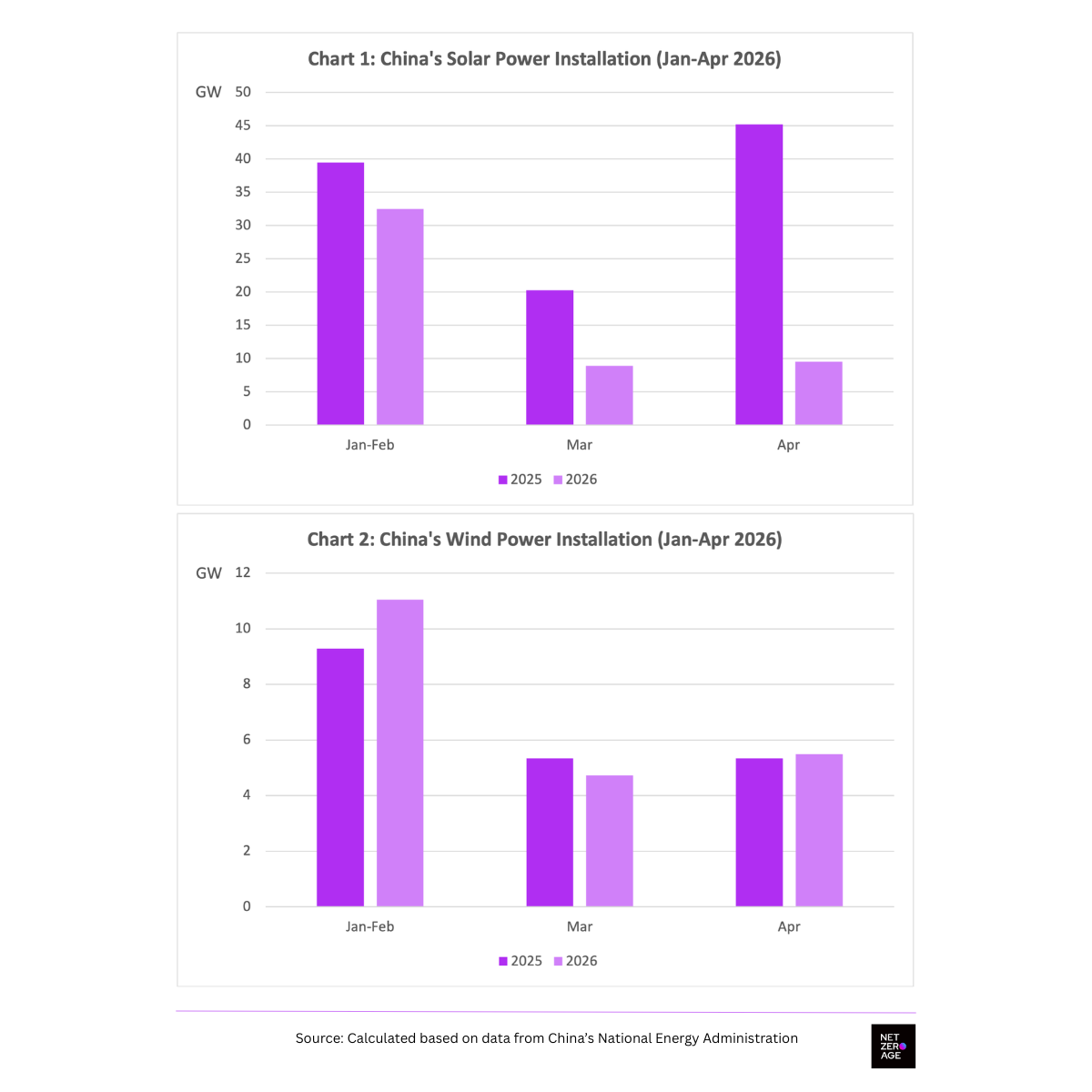

China’s Newly Installed Power Capacity Surpasses 100 GW in First 4 Months, while new solar PV installations in April fell by 78% YoY China’s National Energy Administration (NEA) published its latest power sector statistics on May 25, showing a 78% year-on-year decline in newly installed solar PV capacity in April. From January to April 2026, China added 50.91 GW of solar PV capacity, down 51.48% year-on-year. New wind power installations reached 21.62 GW, up 6.51% year-on-year. And the newly installed power capacity in the first four months of the year reached 106.24 GW. By the end of April 2026, China’s total installed power capacity had reached 3,990 GW. Solar PV accounted for 1,250 GW, or 31.3% of the total, while wind power reached 660 GW, accounting for 16.5%. On a monthly basis, the decline in new solar PV installations continued to widen. New PV capacity additions fell by 17.71% year-on-year in the January–February period, followed by a 55.98% decline in March. The slowdown comes after China advanced market reform of tariffs for renewable power in 2025. Under the new framework effective from June 1, 2025, the tariffs and contracted volumes for newly grid-connected renewable projects are mostly determined through market trading. This trigger a massive solar installation rush prior to June 2025, and has increased uncertainty over future cash flows for power plants, making investors more cautious in assessing project returns. Although the policy introduces a contract for difference (CfD) auctions to provide a floor for project revenues, its coverage is limited, leaving more new installations directly exposed to fluctuations in market-based power price.
The rapid expansion of renewable energy capacity has put pressure on grid integration and consumption. According to China’s renewable energy grid integration and consumption data for January–March 2026, released by the National Energy Administration, the utilization rate was 91.2% for solar PV and 91.9% for wind power. China’s renewable power utilization rate has declined for three consecutive years, with some regions already approaching or falling below the 90% mandated threshold.

Contact Us:zerocarbon2060@outlook.com




copyright@2025 零碳时代,All Rights Reserved 备案号:闽ICP备14008486号-14
Fill out the form to receive a free electronic version of the magazine